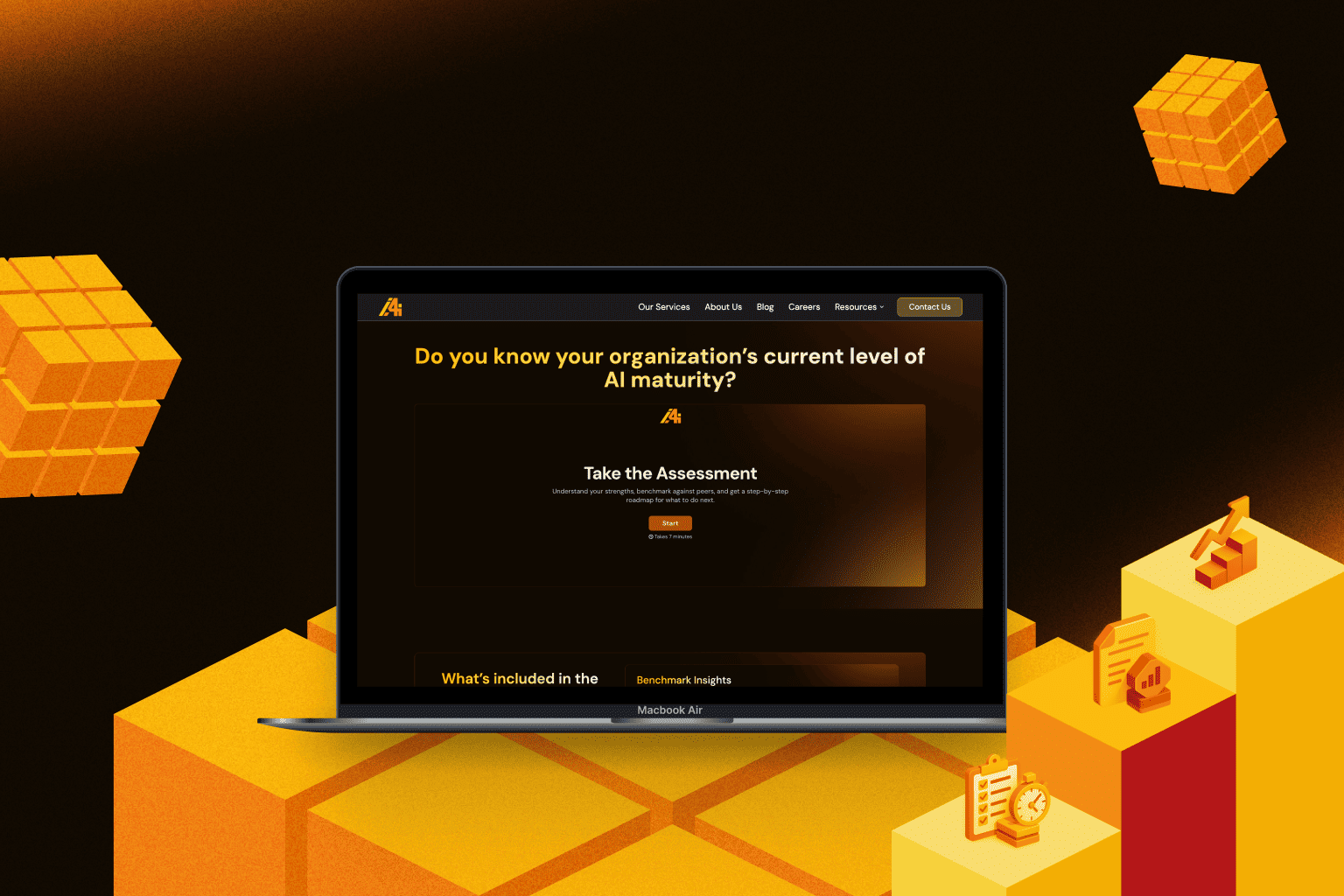
AI is evolving faster than any technology before it. Yet while nearly every organization experiments with AI tools, only a very small percentage actually know how prepared they are to adopt AI effectively and scale it across the business.
This preparedness is what we call AI Maturity - a structured way to measure how ready your organization is to use, scale, and govern AI responsibly and strategically.
At iForAI, we built our AI Maturity Framework to help organizations move from experimentation to execution with clarity, benchmarks, and a roadmap.
This guide explains:
- What AI maturity means
- The four pillars of the iForAI framework
- How maturity is measured
- What a real AI Maturity Report includes
- Why it matters for organizations today
What Is AI Maturity?
AI Maturity is the level of readiness an organization has to adopt, scale, and govern AI effectively.
It answers the question:
“How prepared are we to use AI in a way that is safe, efficient, and strategic?”
AI maturity is not about how many tools you use.
It is about:
- how well your teams understand AI,
- how ready your processes and data are,
- how scalable your infrastructure is,
- and how responsibly you manage AI risks.
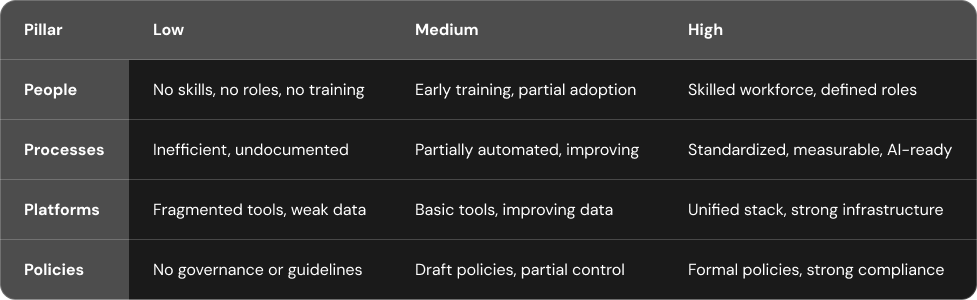
In iForAI’s methodology, AI maturity is measured across four foundational pillars the structural backbone of our entire framework.
The 4 Pillars of the iForAI AI Maturity Framework
Report evaluates your organization across People, Processes, Platforms, Policies, exactly as in the template pages 3–5 of the report.
1. People - Skills, Culture, Leadership
This pillar measures:
- AI fluency
- Skills & training
- Leadership sponsorship
- Defined roles (AI champions, owners, stewards)
🔴 Low People Maturity
Low people maturity means your workforce is not yet ready to adopt AI effectively. This typically includes:
- AI is used occasionally, inconsistently, or only by a few enthusiastic individuals
- No defined roles (no AI Champions, Owners, or Leads)
- Little to no formal AI training or enablement
- Employees lack confidence in using AI tools correctly
- Leadership supports AI verbally but not behaviorally
- Culture is driven by experimentation without direction
- Teams rely on trial-and-error instead of structured adoption
Low people maturity results in slow adoption, hesitation, and internal misalignment.
🟡 Medium People Maturity
Medium maturity means the organization is actively developing AI capability, but not yet at scale:
- Some employees use AI regularly, though adoption varies widely
- At least one informal “AI champion” emerges within the team
- Early training initiatives or AI workshops are introduced
- Leadership supports AI and encourages use, but strategy is still emerging
- Employees show growing confidence, but knowledge gaps remain
- Teams begin to document AI workflows or best practices
- The culture shifts from experimentation to learning and improvement
Medium maturity organizations are building momentum, but require structure to scale.
🟢 High People Maturity
High people maturity means the organization has a strong, confident, AI-capable workforce:
- Clear roles exist: AI Champions, AI Owners, AI Stewards
- AI training programs are standardized, ongoing, and role-specific
- Employees confidently use AI in daily work across functions
- Leadership actively models AI use and drives adoption
- Teams collaborate using shared AI playbooks and internal guidelines
- Culture embraces structured experimentation and responsible use
- New hires are evaluated on AI fluency or willingness to learn
High maturity organizations move fast, innovate consistently, and scale AI effectively.
2. Processes - Workflows, Data, Governance
This pillar evaluates:
- Automation level
- Workflow integration
- Data readiness
- Consistency and standardization
🔴 Low Process Maturity
Low maturity in processes means AI adoption is blocked by operational inconsistency:
- Workflows are manual, siloed, or undocumented
- Data is inconsistent, incomplete, or not AI-ready
- No clear prioritization for automation opportunities
- Experiments happen ad hoc with no evaluation criteria
- Governance is reactive or non-existent
- AI outputs are not measured or validated
- Teams rely on individual initiative instead of shared processes
This results in inefficiency, duplication of work, and limited scalability.
🟡 Medium Process Maturity
Medium process maturity means the organization has started building structure, but not at full maturity:
- Some workflows are partially automated or augmented by AI
- Teams begin documenting processes and AI use patterns
- Data is improving but still inconsistent across systems
- Experiments are run more intentionally, sometimes with basic success metrics
- Governance conversations begin, though not fully implemented
- Early evaluation frameworks for AI outputs appear
- Cross-team collaboration improves, but remains uneven
Medium maturity organizations are preparing for scale but need refinement.
🟢 High Process Maturity
High maturity means the organization has strong, well-structured, AI-ready processes:
- Workflows are standardized and designed for AI integration
- Data is clean, consistent, governed, and easily accessible
- Automation opportunities are mapped and prioritized
- Experiments follow formal evaluation frameworks (impact, feasibility, accuracy)
- Clear governance and review mechanisms exist
- AI outputs are validated, logged, and continuously improved
- Processes enable fast iteration and safe scaling across the business
High maturity organizations can deploy and scale AI efficiently and responsibly.
3. Platforms — Tools, Infrastructure, Orchestration
This pillar looks at:
- AI tool stack
- Data infrastructure
- Automation tools
- MLOps readiness
🔴 Low Platform Maturity
Low platform maturity means the tech stack is not yet prepared for AI scaling:
- Teams rely on fragmented tools or consumer-grade solutions
- No integration between systems
- Limited automation tools or orchestration layers
- Weak data infrastructure (poor quality, low visibility, messy storage)
- No MLOps or monitoring of AI models
- Security gaps or unclear access management
This environment limits experimentation and makes scaling risky.
🟡 Medium Platform Maturity
Medium maturity means the organization has basic tools and is starting to modernize:
- Some AI tools are standardized across teams
- Early integrations appear between core systems
- Data pipelines improve but are not fully automated
- Infrastructure supports small-scale pilots
- Early monitoring or version control practices exist
- Teams explore automation (e.g., RPA, copilots, internal agents)
The foundation exists, but scalability requires refinement.
🟢 High Platform Maturity
High platform maturity means the tech environment is robust, scalable, and AI-ready:
- A unified AI tool stack with clear ownership and governance
- Strong data infrastructure with automated pipelines
- Reliable orchestration systems for workflows and automation
- MLOps practices for model monitoring, deployment, and lifecycle management
- High security, compliance, and access control
- Tools integrated across departments for seamless AI workflows
Organizations with high maturity can scale AI confidently and safely.
4. Policies — Ethics, Compliance, Internal Guidelines
This is about:
- Governance
- Risk management
- Privacy & security
- Responsible AI guidelines
- Documentation
🔴 Low Policy Maturity
Low maturity means the organization lacks responsible AI foundations:
- No formal AI policies or guidelines
- AI risks are not assessed or documented
- No approval process for new AI tools
- Privacy, bias, and security are not consistently addressed
- Teams rely on intuition rather than governance
- Compliance is reactive, not proactive
This creates exposure to legal, ethical, and operational risks.
🟡 Medium Policy Maturity
Medium maturity means the organization has early governance steps, but not full enforcement:
- Draft or emerging AI policies exist
- Some risk assessments are performed, though inconsistently
- Partial tool approval workflows exist
- Early privacy and bias considerations are included
- Teams have basic guidelines but apply them unevenly
- Governance roles start forming (data owners, policy stewards)
The foundation is there, but governance is not yet scalable.
🟢 High Policy Maturity
High maturity means the organization has strong, responsible, standardized AI governance:
- Formal AI policies, guidelines, and playbooks
- Clear approval process for AI tools
- Regular risk assessments, audits, and model reviews
- Active work on bias, fairness, security, and transparency
- Defined governance roles and accountability
- Compliance integrated into workflows
- Ethical AI becomes a cultural norm
High maturity organizations scale AI with confidence, safety, and credibility.
Summary
How We Measure AI Maturity: The Index, Methodology, and Scoring System
Your AI maturity score is calculated through a structured, multi-layered approach. We combine qualitative and quantitative signals into a clear, comparable index.
1. Pillar Scores (1–5 scale)
Each of the four pillars - People, Processes, Platforms, and Policies - is evaluated on a 1–5 scale.
Every pillar is broken down into sub-dimensions (for example: fluency, sponsorship, role coverage, data readiness, governance, etc.), which are scored individually and then aggregated into a single score per pillar.
2. Overall Maturity Score (0–100)
The pillar scores are then combined into a weighted composite score on a 0–100 scale.
This becomes your overall AI maturity score and is mapped to a specific maturity stage (e.g. Exploring, Piloting, Scaling, Leading), giving you a clear view of where your organization currently stands on the AI journey.
3. Benchmarking Against Industry Peers
Your results are not evaluated in isolation.
We compare your scores against:
- The median scores in your industry
- Organizations of a similar size
- The broader sector maturity
This benchmarking shows whether you are ahead of, aligned with, or behind comparable organizations in each pillar.
4. Gap and Opportunity Analysis
Finally, we identify your most important maturity gaps and growth opportunities.
This includes:
- The top three gaps that are slowing down your AI progress
- The key risks (e.g. lack of governance or weak infrastructure)
- The highest-potential opportunities where focused effort can create outsized impact
These insights feed directly into your tailored recommendations, recommended use cases, and prioritized roadmap.
AI Maturity Stages
In the iForAI framework, every organization is mapped to one of four AI maturity stages:
Stage 1 – Exploring
AI is mostly driven by curiosity. Teams experiment informally with tools, but there is no structure, strategy, or clear ownership.
Stage 2 – Piloting
The organization is running early pilots and seeing some initial wins. However, efforts are fragmented, and AI is not yet scalable or embedded into core operations.
Stage 3 – Scaling
AI is integrated into key workflows, supported by improving data quality and more stable platforms. Governance and processes begin to formalize, enabling repeatable results.
Stage 4 – Leading
AI is a strategic engine for the business. Clear governance is in place, infrastructure is robust, automation is widespread, and AI consistently drives measurable impact across the organization.
What’s Inside the AI Maturity Report (Your Report Structure)
Your AI Maturity Report is a structured, actionable overview of your organization’s AI readiness. It includes:
1. Executive Summary
A concise overview of your overall AI maturity score, your stage on the maturity curve, and the key headline findings.
2. Scoring Breakdown
A detailed, pillar-by-pillar view of your results across People, Processes, Platforms, and Policies, including the underlying subdimensions that drive each score.
3. Benchmarking & Gap Analysis
Comparisons of your scores against industry medians and similar organizations, highlighting where you are ahead, aligned, or lagging, and where the largest gaps appear.
4. Top Gaps to Address
A focused view of the three highest-priority areas that are currently limiting your AI progress and require immediate attention.
5. Recommended Use Cases
A curated set of AI use cases tailored to your context. For each use case, you’ll typically see:
- Impact
- Feasibility
- Priority (based on impact × feasibility)
- Why this use case matters for your organization
- A real-world example to illustrate its potential
6. Prioritized Roadmap (30–60–90 days → 6 months)
A three-phase roadmap that translates insights into action, usually structured as:
- Quick Win – a fast, low-risk initiative to demonstrate value
- Momentum Builder – a broader initiative that builds on the first success
- Strategic Bet – a longer-term, high-impact initiative that positions you for leadership
7. Detailed Pillar Analysis
An in-depth narrative for each pillar (People, Processes, Platforms, Policies), explaining your scores, strengths, and weaknesses, often supported by visualizations.
8. Next Steps
Clear recommendations on how to move forward - from strategy sessions to implementation support - so you can turn your report into measurable business impact.
Why AI Maturity Matters Right Now
Organizations with higher AI maturity:
- scale AI 5× faster
- automate more safely
- reduce costs and manual work
- innovate continuously
- avoid compliance risks
- build long-term competitiveness
Organizations with low maturity:
- struggle with adoption
- face fragmented tools & data
- can't scale pilots
- risk compliance violations
- waste budget
- lose competitive positioning
Your maturity level determines your AI future.
How to Measure Your AI Maturity
You can measure your maturity in 3 steps:
1. Take the Assessment (≈7 minutes)
You answer questions similar to those shown at the end of the sample report (Appendix A).
2. Receive Your AI Maturity Report
A full analysis based on the exact structure you saw above.
3. Plan Your Next Steps with iForAI
Roadmap execution, capability building, pilot projects.
Start Your AI Readiness Journey Today
Understanding your AI maturity is the first step toward:
- clarity
- direction
- safe scaling
- strategic investment
- long-term competitive advantage

Valeriia Havrylenko
Marketing Manager