



AI Transformation for

Manufacturing Companies

We help mid-market manufacturers use AI to close data gaps, reduce margin leakage, and move from pilot to production value — without replacing existing systems.
Modern office setting with people working at computers and overlay graphics showing weekly growth up 28% and revenue lift up 35%.
Gradient background with bright orange and yellow at the bottom fading into black towards the top.
Manufacturers and operators trusted by AI experts and production leaders
amdocs
monday.com logo
Expedia

adopt AI that actually improves operations? How can mid-market manufacturers

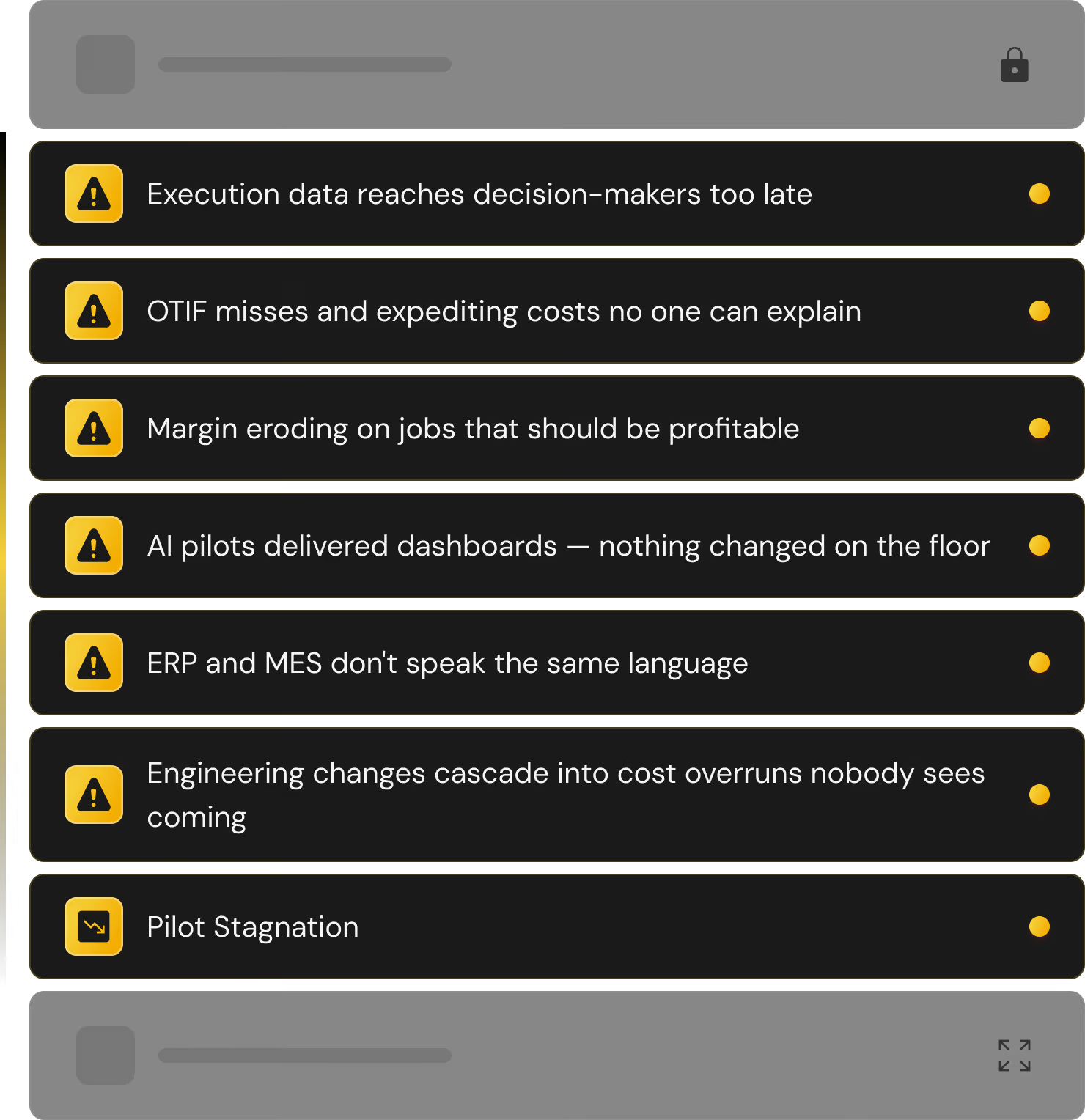
Manufacturers operate across shifts, machines, suppliers, and ERP systems — making AI adoption complex without the right operational foundation. Most initiatives stall at proof-of-concept, produce dashboards nobody acts on, and never reach the floor.
List of travel and hospitality companies journey pain points with warning icons, including fragmented journeys, demand forecasting uncertainty, high operational complexity, personalization pressure, and data spread across vendors.Notification panel highlighting 'Pilot Stagnation' with the message 'ROI not realized' and a yellow alert icon.

How iForAI Helps

Manufacturing Companies

AI Diagnostics
Identify your highest-value AI opportunities across operations, data flows, and workflows — mapped to your specific manufacturing environment.
Embedded Execution
Build and deploy AI solutions that integrate with your existing ERP, MES, and shop floor systems. No rip-and-replace. No platform lock-in.
Team Enablement
Upskill operations, engineering, and management teams to use AI tools confidently in daily work — not just in a pilot lab.

Results you can achieve

with iForAI

Measurable impact across operations, margin, and execution.
AI Adoption Growth
+56%
Avg. in AI readiness
Projects Delivered
150+
From ideas to working solutions
Global Team Engagement
1500+
Participants across US, Europe, and Asia
Logos of Expedia, Amdocs, and NIST displayed on dark circular backgrounds.
Trusted by PE firms and 100+ teams worldwide

AI built for how you

actually manufacture

Different manufacturing operations have different AI entry points. Here's where we start.

High-Mix Job Shop

High-Volume Assembler

Regulated Batch

Engineer-to-Order

Continuous Process / Asset-Heavy

Contract Manufacturer

High-Mix Job Shop

Pain Point

Quote accuracy & margin erosion on repeat jobs

AI Solution

Quote-vs-actual analyzer — surfaces which job types lose margin and why

Timeline

6 Weeks

Outcome

–23% Variance

High-Mix High-Volume Assembler

Pain Point

OTIF misses and ERP-to-floor data gaps

AI Solution

OTIF root-cause engine — identifies the recurring patterns behind delivery failures

Timeline

3 Weeks

Outcome

67% Traced

Regulated Batch

Pain Point

Audit burden, batch traceability, deviation management

AI Solution

Compliance visibility layer — automates batch documentation and flags deviations in real time

Timeline

8 Weeks

Outcome

3 Weeks → 4 Days

Engineer-to-Order

Pain Point

Estimate-vs-actual drift and engineering change cost escalation

AI Solution

Project margin analyzer — tracks cost performance in real time and surfaces overrun risk early

Timeline

6 Weeks

Outcome

3 Weeks earlier

Continuous Process / Asset-Heavy

Pain Point

Unplanned downtime and yield variability

AI Solution

Predictive maintenance wedge — targets the highest-cost failure mode first

Timeline

90 days

Outcome

–34% Downtime

Contract Manufacturer

Pain Point

Multi-customer scheduling conflicts and hidden capacity slack

AI Solution

Capacity intelligence engine — optimizes scheduling across customer programs and surfaces conflicts before they become misses

Timeline

4 Weeks

Outcome

$180K Recovered

Case Studies

A young woman wearing a headset and blue sweater working at a customer support workstation with a desktop monitor and laptop displaying software dashboards, seated in a modern creative office with brick walls, shelving, and colorful decor in the background
Execution
How an Emergency Tech Company Scaled Support Operations with AI Without Adding Headcount
A global emergency tech company was drowning in manual support workflows. iForAI deployed AI agents and automated data pipelines, turning reactive support into a scalable, insight-driven operation.
Read More
Arrow right icon
 male doctor wearing a stethoscope, dress shirt, and tie reviewing patient information on a digital tablet with a female nurse in teal scrubs, while two other healthcare staff members are visible in the blurred background of a hospital corridor
Execution
RFP Processing That Used to Take Days Now Happens in Minutes
High-volume RFPs were slowing down a healthcare distributor's sales cycle. iForAI built an AI-powered workflow that auto-processes requests, reduces errors, and lets the team close deals faster.
Read More
Arrow right icon
A female scientist wearing a white lab coat, safety glasses, and blue gloves working at a laboratory workstation with a glass filtration apparatus, blood sample test tubes, a microscope, and a computer monitor displaying DNA research data in a modern resea
Execution
A Biotech Company Went from Manual Diagnostics to Real-Time AI Monitoring Across Every Pipeline
Investigating system failures was slow and manual. iForAI deployed an AI investigation agent that continuously monitors data pipelines, flags anomalies, and generates reports automatically.
Read More
Arrow right icon
 A person using a stylus on a tablet with a holographic AI security shield and digital interface elements floating above the device, representing artificial intelligence protection and smart technology
Execution
Insurance Quotes in Minutes, Not Days: How One Distributor Automated Its Entire Request Workflow
Customers were sending quote requests via email, chat, and phone, and response times were painful. iForAI built a unified AI layer that captures, classifies, and responds across all channels in real time.
Read More
Arrow right icon
Three colleagues collaborate in an office, one writing ideas on a glass board while the others observe and discuss.
Upskilling
One Hackathon. 36% More AI-Ready Employees. Here's the Playbook.
A global SaaS company needed their whole team (engineers and non-technical staff alike) to actually use AI. iForAI ran a structured hackathon that turned skeptics into practitioners, fast.
Read More
Arrow right icon
Team members collaborate at a desk, reviewing work on a laptop during a focused meeting.
Strategy
From AI Experiments to Enterprise Standard: How a Global Tech Company Made AI Stick
Pockets of AI use existed but nothing was coordinated. iForAI built the strategy, governance, and adoption framework that turned scattered pilots into a company-wide competitive advantage.
Read More
Arrow right icon
Four colleagues gather around a laptop, discussing ideas in a modern office lounge.
Strategy
Rethinking IT from the Top: How a Fortune 500 Travel Company Built an AI-First CIO Organization
The CIO org needed more than new tools; it needed a new operating model. iForAI redesigned how people, processes, platforms, and policies work together to put AI at the centre of IT decision-making.
Read More
Arrow right icon
A business manager in a suit holding a clipboard leading a team briefing in an industrial facility, presenting production schedule charts on a wall board to a diverse group of workers in casual work attire and a female colleague in business casual clothing
Execution
Better Margins, Zero New Hires: How AI Validation Cleaned Up a Distributor's Order Chaos
Orders were arriving across email, WhatsApp, and warehouse systems with no unified validation. iForAI deployed an AI layer that checks every order and payment in real time, catching errors before they cost margin.
Read More
Arrow right icon

Frequently

Asked Questions

Everything you need to know about our process, capabilities, and how we ensure successful AI transformation in manufacturing.

Can AI improve our operations without replacing our ERP or MES?

Keyboard arrow up icon

Yes. This is one of the most common concerns we hear from manufacturing teams. iForAI integrates with your existing ERP, MES, and data infrastructure — we do not require a platform change or data migration as a prerequisite. We build on top of what you already have and fix data gaps as part of the engagement.

Our data is fragmented across shifts, machines, and systems. Can AI still work?

Keyboard arrow up icon

Yes — fragmented data is the norm in manufacturing, not the exception. We start by mapping where operational data already flows, identify where it breaks down, and build the AI capability on top of the most reliable data sources first. We improve data quality as a byproduct of deployment, not as a prerequisite.

How quickly can AI deliver measurable results in a manufacturing environment?

Keyboard arrow up icon

Often within 4–8 weeks for a focused operational use case. We target one specific pain point — a single 'operating wedge' — and measure the result before expanding. This is deliberately different from large-scale transformation programs that take 12–18 months before anything is visible on the floor.

Do we need in-house AI expertise to run these solutions after deployment?

Keyboard arrow up icon

No. We design AI systems that operations, engineering, and management teams can use and understand — without needing data scientists or AI specialists on staff. Where ongoing maintenance is needed, we provide it or transfer knowledge to your team as part of the engagement.

Is AI mainly useful for large manufacturers, or does it work for mid-market companies?

Keyboard arrow up icon

Mid-market manufacturers often see faster and higher ROI because they can move quickly, have less organizational complexity, and can implement without a large procurement process. Our ICP is specifically 50–2,500 employee manufacturers — the full range of mid-market manufacturing is where we work best.

We've run AI pilots before and they didn't stick. Why would this be different?

Keyboard arrow up icon

Most AI pilots fail not because the technology doesn't work, but because they start with a tool and never target a specific economic outcome. Every iForAI engagement begins with a named margin or cost impact target — and we don't leave until we can measure against it. The operating wedge approach is specifically designed to break the pilot cycle.

Move From Pilot to

Production Value in Manufacturing

Talk to AI Expert
Exit cross icon
Exit cross icon